AWS vs Azure for Startups: Which Cloud Wins?
Picking between AWS and Azure is one of the first infrastructure decisions your startup makes, and one of the hardest to undo. Your team learns one provider’s tools, your architecture molds around its services, and your hiring starts filtering for people who know that stack. Get it right and the cloud disappears into the background.
This guide compares aws vs azure for startups on what actually matters to an early-stage company: real costs, free credits, ease of use, hiring, and how painful it is to change your mind later.
Table of Contents
- AWS vs Azure for Startups: Which Costs Less?
- AWS Activate vs Microsoft for Startups: Credits Compared
- Which Cloud Is Easier for a Small Team to Run?
- AWS vs Azure for Startups: The Hiring Question
- Building an AI Startup? Read This First
- How Hard Is It to Switch Clouds Later?
- The Decision Framework: Pick by Your Stage
- 7 Mistakes Startups Make Choosing a Cloud
- Can You Use Both?
- Conclusion
- FAQ
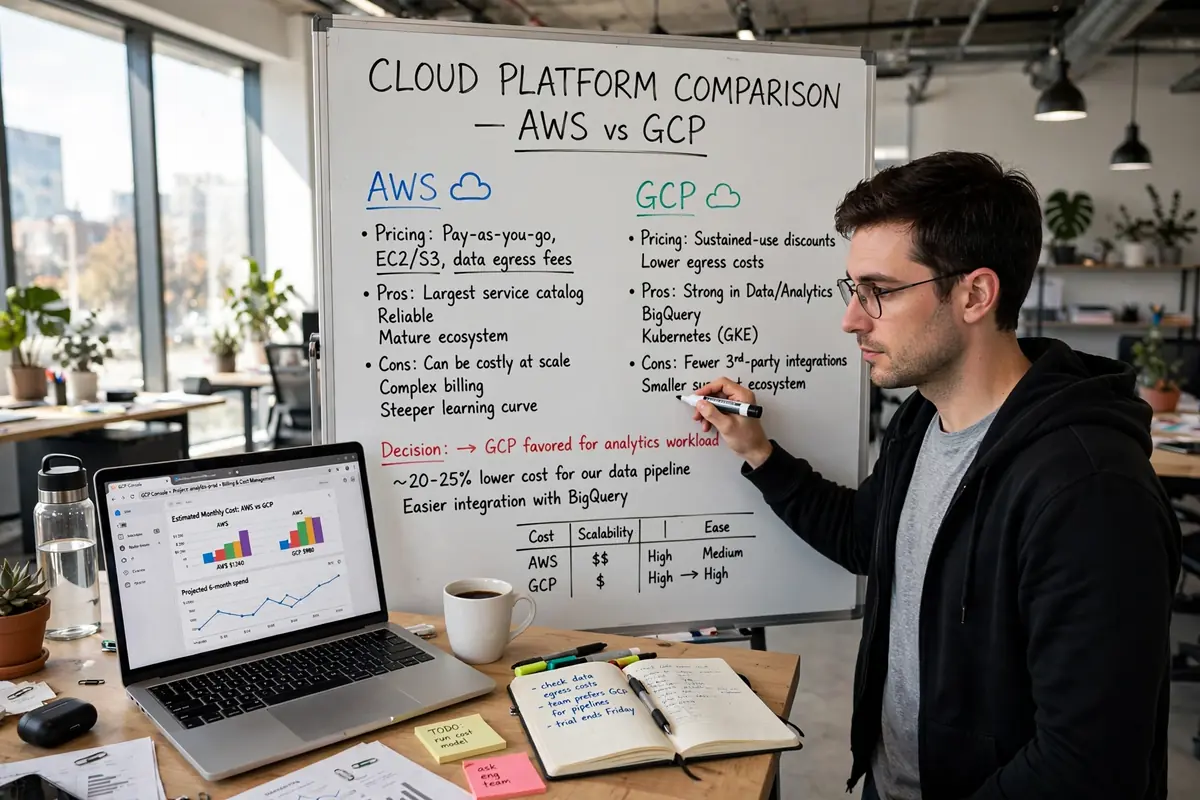
The short answer: most startups should pick AWS for its larger talent pool, deeper startup credit program, and the sheer number of solved problems in its ecosystem. Pick Azure if your team already lives in the Microsoft world (.NET, Windows, Microsoft 365) or you’re selling to enterprise customers who do. If you’re pre-seed and bootstrapped, take whichever credits you can get fastest and don’t overthink it.
[IMAGE 1: AWS vs Azure for startups featured image showing a founder comparing two cloud platforms]
AWS vs Azure for Startups: Which Costs Less?
Neither cloud is consistently cheaper. For a typical early-stage web app (a few servers, a managed database, object storage, and a CDN), monthly bills land in a similar range on both platforms, often a few hundred dollars before credits. AWS tends to win on compute discounts through Savings Plans, while Azure can be cheaper if you already hold Microsoft licenses. The real cost difference comes from architecture choices, not the provider.
Cloud pricing changes constantly, so treat any specific number you read online as a snapshot, not a promise. What matters is knowing where the money goes:
- Compute (virtual servers or containers): usually the biggest line item. Both offer pay-as-you-go, 1-3 year reserved discounts, and cheap spare-capacity options (Spot Instances on AWS, Spot VMs on Azure).
- Managed databases: a managed Postgres instance costs roughly the same on RDS (AWS) and Azure Database for PostgreSQL. The price gap is small; the operational difference matters more.
- Object storage: S3 and Blob Storage price similarly for standard storage. Watch the request pricing if you serve millions of small files.
- Data egress (data leaving the cloud): the silent budget killer on both platforms. Serving video or large downloads gets expensive fast, so design around it early.
- Support plans: AWS Business Support and Azure Standard Support both start around $100/month minimum or a percentage of your bill. Startup credit programs often bundle support credits too.
Here’s a realistic walkthrough. Imagine a SaaS MVP: two small app servers, one managed Postgres database, 500 GB of object storage, and a CDN. Before discounts, that’s roughly $300 to $600 per month on either cloud. With startup credits applied, the bill is effectively zero for your first year or two, which is exactly why credits should weigh heavily in your decision.
Want to model your own stack? Run the numbers yourself with our cloud cost calculator before you commit, and read our detailed AWS vs Azure vs Google Cloud pricing breakdown for the full comparison.
AWS Activate vs Microsoft for Startups: Credits Compared
AWS Activate offers the larger headline amounts: self-serve founders start around $1,000, while venture-backed startups can access up to $100,000 or more through accelerator and VC partner channels. Microsoft for Startups gives $1,000 to $5,000 self-serve with no investor backing required, scaling up to $150,000 through its investor network. Bootstrapped with no network? Microsoft’s entry path is friendlier. Funded? AWS’s ceiling is higher.
Both programs are application-based, not automatic. Here’s how they stack up:
AWS Activate
- Founders tier: starts around $1,000 in credits, open to self-funded startups with a live website and business email. Approval typically takes a few business days.
- Portfolio tier: up to $100,000+ for startups connected to a recognized accelerator, incubator, or VC. Request your partner’s Organization ID the day you join the program, not the day you apply.
- AI-focused startups can access larger amounts through dedicated AI tracks. Credits are generally valid for about two years and work across 200+ services including Bedrock.
- Apply: AWS Activate
Microsoft for Startups Founders Hub
- Self-serve path: $1,000 to $5,000 in Azure credits with no funding or backing required. The easiest serious cloud credit in the industry to get.
- Investor network path: up to $150,000 in credits, released in stages as you hit milestones.
- Bundles GitHub Enterprise, Microsoft 365, and Visual Studio subscriptions, plus access to Azure OpenAI Service.
- Apply: Microsoft for Startups Founders Hub
One practical note: credits expire. Founders routinely burn credits on oversized infrastructure and then face a shocking first real bill. Set billing alerts on day one, on either cloud.
[IMAGE 2: Startup founders reviewing AWS vs Azure for startups credit options on a laptop]
Which Cloud Is Easier for a Small Team to Run?
Azure is generally easier for teams coming from a Microsoft background, with a portal many find cleaner and tight integration with tools like GitHub and VS Code. AWS has a steeper learning curve because of its enormous service catalog, but it also has far more tutorials, Stack Overflow answers, and managed-service patterns to copy. For a team of 2-5 engineers, both are manageable if you stay disciplined about using only the services you need.
The honest truth: the number of services is irrelevant to a six-person team. You’ll use maybe ten. What matters is documentation, community, and staying disciplined:
- Docs and community: AWS wins. Whatever breaks at 2 AM, someone has written about it.
- Console experience: Azure’s portal feels more modern; AWS’s console is powerful but cluttered.
- Infrastructure as code: Both support Terraform well.
- Managed Kubernetes: EKS and AKS both work, but neither is fun at startup scale. Try serverless containers (Fargate on AWS, Container Apps on Azure) before committing to Kubernetes at all.
If your team has zero cloud experience, the fastest path is whichever cloud your most senior engineer already knows. Team knowledge beats feature checklists every time.
AWS vs Azure for Startups: The Hiring Question
AWS has the largest cloud talent pool by a wide margin, which means faster hiring and more contractors available. Azure talent is plentiful too, especially in enterprise-heavy regions, but the pool skews toward corporate IT backgrounds rather than startup-style builders. If you plan to scale an engineering team quickly, AWS gives you the most options.
This is the factor founders underestimate most. AWS-tagged startup roles outnumber Azure ones, and freelance DevOps engineers with deep AWS experience are easier to find. Azure specialists cluster in finance, healthcare, and government-adjacent markets; if those are your customers, Azure experience on the team is a genuine selling point.
For a technical founding team doing its own DevOps in year one, this matters less. For a non-technical founder hiring a first engineering team, it matters a lot.
Building an AI Startup? Read This First
If your product is built on large language models, Azure has a real edge through Azure OpenAI Service, which offers enterprise-grade access to OpenAI models with data privacy guarantees. AWS counters with Bedrock, which gives you a choice of models from multiple providers (Anthropic, Meta, Mistral, and Amazon’s own) behind one API. For training custom models, both offer GPU instances, but availability is tight everywhere, so apply for credits early.
A few AI-specific realities:
- Model API access: Azure OpenAI Service is the most compliance-friendly route to OpenAI models. Bedrock’s multi-model approach avoids single-vendor dependence.
- GPU availability: Both clouds ration high-end GPUs. Startup programs sometimes include GPU quota, which can matter more than generic credits.
- Cost warning: inference and training bills scale brutally. Negotiate credits specifically for AI workloads and architect with cost caps from day one.
How Hard Is It to Switch Clouds Later?
Switching clouds is genuinely painful, not impossible. A typical startup migration takes 2-6 months of engineering time, plus the risk of downtime and the cost of running two clouds in parallel. The pain comes from managed services (databases, queues, identity), not raw servers.
Reduce future pain without going overboard: containerize your app from the start, manage infrastructure with Terraform so it’s code and not clicks, and prefer managed Postgres over cloud-specific databases since Postgres runs everywhere. Accept some lock-in for undifferentiated heavy lifting like object storage and CDNs; rebuilding those yourself costs more than the theoretical freedom.
The Decision Framework: Pick by Your Stage
Pre-seed and bootstrapped: take the credits you can get fastest. Microsoft’s self-serve Founders Hub path or AWS Activate Founders tier both work. Don’t spend three weeks debating; spend it shipping.
Seed stage with a technical team: default to AWS unless your team already knows Azure deeply. The talent pool, community, and credit ceiling favor AWS here.
Selling to enterprise: seriously consider Azure. If your buyers run on Microsoft 365 and Entra ID, Azure removes procurement friction and gives sales a real talking point. Microsoft’s co-sell programs can directly drive revenue.
AI-first startup: compare Azure OpenAI Service against Bedrock for your specific models, then follow the credits. GPU quota availability may decide for you.
Quick quiz:
- Does your lead engineer already know one cloud well? Pick that one.
- Are your target customers large enterprises on Microsoft? Lean Azure.
- Are you bootstrapped with no network? Take Microsoft’s self-serve credits now; revisit at seed.
If all three answers are “neither,” pick AWS. It’s the default for a reason.
[IMAGE 3: Cloud cost dashboard showing AWS vs Azure for startups billing comparison]

7 Mistakes Startups Make Choosing a Cloud
- Choosing on headline credit amounts alone. $150,000 in credits burned in 8 months on oversized servers beats nothing; $5,000 stretched across 18 months on lean architecture beats both.
- Ignoring credit expiry dates. Credits vanish whether you used them well or not. Plan architecture around the expiry timeline.
- Over-provisioning from day one. Start with the smallest instances that work. Both clouds scale up in minutes; neither refunds overspending.
- Skipping billing alerts. Set budget alerts at 50% and 80% of expected spend on day one. This one habit prevents the horror stories.
- Letting a non-technical decision-maker pick. The person who’ll operate it at 2 AM should have the deciding vote.
- Going multi-cloud too early. Two clouds double your operational surface for zero benefit at startup scale. Pick one.
- Forgetting about egress. If your product moves lots of data to users, model egress costs before you commit, not after the first bill.
Can You Use Both?
Yes, but you shouldn’t at startup stage. Multi-cloud means two sets of IAM policies, two billing systems, two failure modes, and half the expertise in each. Pick one cloud and go deep. One legitimate exception: putting a best-in-class CDN like Cloudflare in front of either cloud is normal and healthy. That’s just good architecture, not multi-cloud.
Conclusion
The aws vs azure for startups debate has a practical answer, not a theoretical one. AWS is the default for most startups thanks to its talent pool, community, and credit ceiling. Azure is the smarter pick for Microsoft-centric teams and enterprise-focused startups, with the friendliest self-serve credit path for bootstrapped founders.
Key takeaways:
- Apply for startup credits before spending a dollar; they’re the biggest factor in year-one costs.
- Match the cloud to your team’s skills first, features second.
- Set billing alerts on day one and design around data egress.
- Containerize your app and keep infrastructure in code so you’re never trapped.
Next step: apply to AWS Activate or the Microsoft for Startups Founders Hub today (both take under 30 minutes), then model your expected bill with our cloud cost calculator.

FAQ
Is AWS or Azure cheaper for startups?
Neither is consistently cheaper. A typical early-stage app costs roughly the same on both before discounts. AWS often wins on compute through Savings Plans, while Azure can be cheaper with existing Microsoft licenses. Startup credits make the first year effectively free on either, so architecture discipline matters more than the price list.
Which is better for startups, AWS or Azure?
AWS suits most startups because of its larger talent pool, deeper documentation, and broader ecosystem. Azure suits Microsoft-centric teams or startups selling to enterprise customers on Microsoft tools. Most comparisons of aws vs azure for startups land on AWS as the default and Azure as the strategic pick for specific situations.
How much are AWS Activate credits?
Self-serve founders typically start around $1,000. Startups connected to accelerators or VCs can access up to $100,000 or more through the Portfolio tier, and AI startups may qualify for larger amounts. Amounts change, so check the official AWS Activate page for current figures.
How much are Microsoft for Startups credits?
The self-serve Founders Hub path offers $1,000 to $5,000 in Azure credits with no investor backing required. Through the investor network path, startups can receive up to $150,000 in credits released in stages, plus GitHub, Microsoft 365, and Azure OpenAI access.
Do I need funding to get startup cloud credits?
No. Both AWS Activate (Founders tier) and Microsoft for Startups (self-serve path) accept bootstrapped startups. You generally need a live company website, a business email on your own domain, and a LinkedIn profile for verification.
Is Azure easier to learn than AWS?
For teams with Microsoft experience, yes. Azure’s portal and familiar tooling flatten the learning curve. For everyone else, AWS’s far larger tutorial and community ecosystem usually makes problem-solving faster.
Can I switch from AWS to Azure later (or vice versa)?
Yes, but budget 2-6 months of engineering time. Managed databases, identity systems, and queues cause the most friction. Containerizing your app and managing infrastructure with Terraform from the start makes any future move dramatically easier.
Which cloud is better for AI startups?
Azure has an edge for OpenAI-model products through Azure OpenAI Service. AWS Bedrock offers more model choice behind one API. For GPU-heavy training, compare quota availability in both startup programs, since GPUs are rationed everywhere.
Should a startup use multiple clouds?
Not at early stage. Multi-cloud doubles operational overhead for no meaningful benefit before you have a dedicated platform team. Pick one primary cloud and add best-in-class third-party services (like a CDN) where they clearly win.
What is the biggest hidden cost in cloud pricing?
Data egress, the fee for moving data out of the cloud to your users. It’s the most common source of surprise bills on both AWS and Azure. If your product serves large files, video, or heavy API traffic, model egress costs before you commit to an architecture.