Python vs JavaScript: Which to Learn First?
Picking your first programming language feels like a big deal, and honestly, it sort of is. Your first language shapes what you build in the first few months, and those first projects keep you going. The python vs javascript debate has raged for years, but here is the truth: both are excellent, both pay well, and most developers learn both. What matters is which fits the next six months of YOUR life.
This guide gives you an honest breakdown of both, a side-by-side comparison, a five-question quiz, 30-day plans for each, and the mistakes beginners keep making.
Want visible, hireable work fast? Learn JavaScript first. Want the gentlest start with data, automation, or AI? Learn Python first. Commit to one for three months before touching the other.
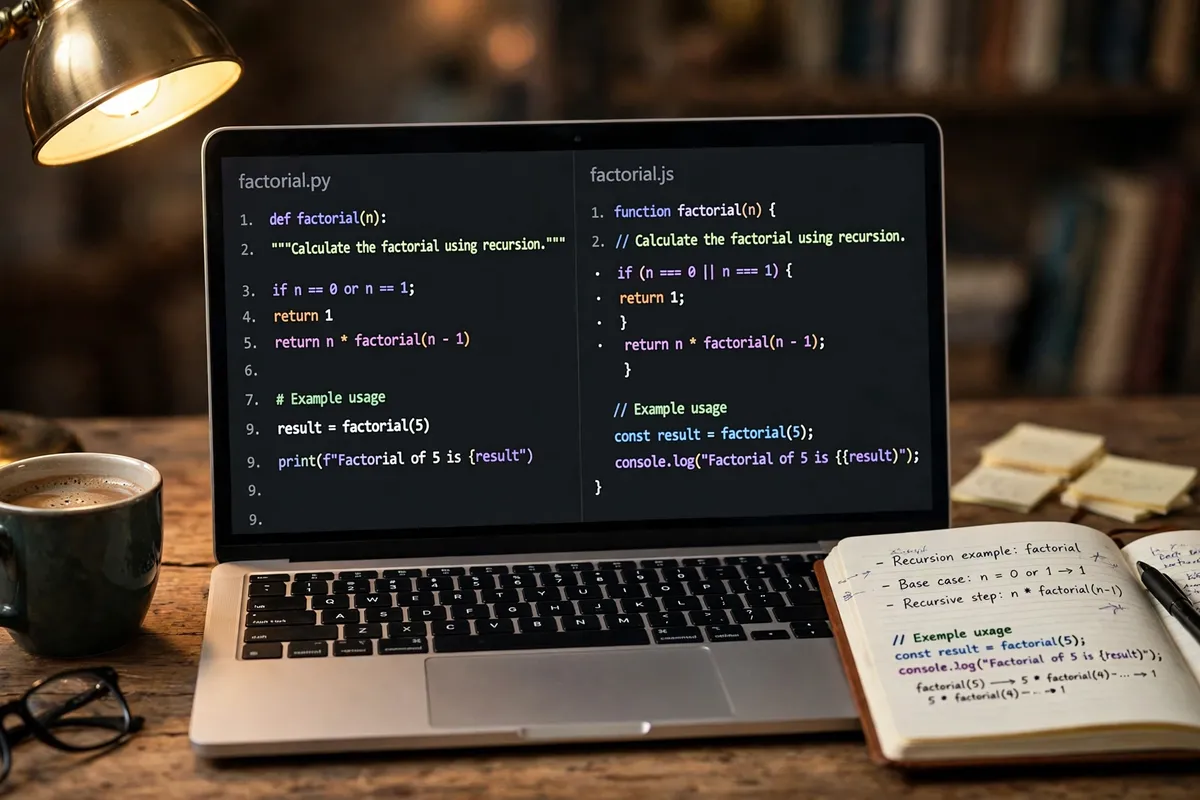
Table of Contents
- What Is Python, Really?
- What Is JavaScript, Really?
- Python vs JavaScript: Side-by-Side Comparison
- Which One Is Easier for a Total Beginner?
- Which Language Gets You Hired Faster?
- Who Should Avoid Which Language?
- The 5-Question Decision Quiz
- Your First 30 Days With Python
- Your First 30 Days With JavaScript
- 6 Mistakes Beginners Keep Making
- Can You Learn Both? How Hard Is Switching?
- Learning to Code With AI Assistants in 2026
- Conclusion
- FAQ
What Is Python, Really?
Python is a general-purpose language famous for reading almost like plain English, which makes it the most recommended first language in schools and bootcamps. It powers data analysis, automation, AI, machine learning, back-end web services, and scientific computing at companies like Instagram, Netflix, and Spotify.
Why do beginners love it? You do meaningful things fast: a script that renames a hundred files, a program that texts you the weather. Almost no setup drama: install Python, open a terminal, and you are writing working code within minutes, spending energy on thinking like a programmer instead of fighting punctuation. Its real superpower is AI: nearly every serious machine learning library, from TensorFlow to PyTorch, is Python-first. If AI excites you, Python is the obvious pick.
What Is JavaScript, Really?
JavaScript is the language of the web browser: dropdowns, animations, live search, online checkouts, all of it runs on JavaScript. Every modern browser understands it natively. No plugins, no downloads. It works the moment someone visits your page.
But JavaScript escaped the browser years ago. With Node.js it runs on servers too, so you can build an entire app, front end and back end, in one language. React, Vue, and Angular are all JavaScript. The curve is spicier: async code and famous quirks take time to click. The payoff is visibility: friends open a link and use what you made, and that feedback loop carries beginners through the hard parts.
Python vs JavaScript: Side-by-Side Comparison
How the two stack up on what beginners care about:
Learning curve
- Python: Gentle. Reads like English, fewer surprises, most beginners write useful scripts within two weeks.
- JavaScript: Moderate. Browser quirks and async add friction, but you see visual results quickly.
What you build first
- Python: Automation scripts, data dashboards, back-end APIs, AI experiments.
- JavaScript: Interactive websites, web apps, browser games, mobile apps, full-stack projects.
Job market
- Python: Strong in data, AI/ML, automation, and back-end roles. Stack Overflow’s 2025 survey showed it gaining the most developer interest of any major language.
- JavaScript: Still the most-used language in the world (about 66% of developers), with huge demand for front-end and full-stack roles.
Salary (entry to mid-level)
- Python: Roughly $75,000 to $130,000 in the USA; AI and data roles sit at the top.
- JavaScript: Roughly $70,000 to $125,000; React and full-stack specialists do well.
- UK: £35,000 to £70,000 for both, with Python data roles slightly ahead in finance and AI.
Freelancing
- Python: Automation gigs, data cleanup, scraping work for small businesses.
- JavaScript: The king of freelance web work; every small business needs a website.
One language, both ends?
- Python: Runs on servers and in data pipelines. Cannot run in the browser natively.
- JavaScript: Runs in the browser AND on servers via Node.js. True full-stack with one language.
Which One Is Easier for a Total Beginner?
Python is easier for most total beginners, and it is not close. Less punctuation noise, readable errors, no browser to understand first. print("Hello") does exactly what it says. JavaScript asks you to juggle the browser, console, and sometimes a build tool first, heavy overhead when you are still learning what a variable is.
But “easier” is not the whole story. Some find JavaScript easier to STICK with because results are visual: a button changing color delivers a dopamine hit, and dopamine gets you to day 30. Quick test: open your browser console (F12) and type alert("hi"). Fun? JavaScript’s instant feedback is your fuel. Messy? Python’s calm style is calling your name.
Which Language Gets You Hired Faster?
For pure speed to a first job or client, JavaScript has a small edge. Front-end roles are plentiful, freelance web work is constant, agencies hire in volume. Income within 6 to 9 months? JavaScript is the pragmatic pick.
Python’s hiring story is different and, for many, better. The AI boom created genuine demand in data, automation, and machine learning, often paying more with thinner entry-level competition. The catch: Python roles more often expect a degree or strong data portfolio, while JavaScript roles mostly care about what you can build.
Regionally: in the USA, Python leads AI hubs like San Francisco while JavaScript dominates startup markets like Austin. In the UK, London finance pays Python data roles well while JavaScript powers agencies. Globally, JavaScript freelance work is easiest to find.
Who Should Avoid Which Language?
Knowing what NOT to pick saves you months.
Skip Python first if: you dream of building websites to show people (Python feels invisible), you want quick freelance work (small businesses need websites), or you dislike math-flavored thinking (its best-paying paths lean into data).
Skip JavaScript first if: syntax anxiety is real (its quirks frustrate early), you are aiming at AI or data science (you will learn Python later anyway), or fast-changing tools overwhelm you (the JS ecosystem reinvents itself yearly).
The 5-Question Decision Quiz
Answer honestly, tally your As and Bs.
1. What sounds more fun to build first?
- A: A program that organizes files, analyzes data, or chats with AI
- B: A website or app I can send to friends
2. Bigger career curiosity?
- A: AI, data science, automation
- B: Web design, startups, freelancing
3. How do you feel about math?
- A: Fine with it, or I want to get better
- B: I would rather deal with layouts and interfaces
4. What motivates you when it gets hard?
- A: Clean logic and solving puzzles
- B: Seeing something visual come alive
5. Where do you want to be in a year?
- A: Automating work or experimenting with AI
- B: Shipping websites or freelancing for clients
Mostly A: start with Python. Mostly B: start with JavaScript. Tied? Pick the one tied to how you want to earn first.
Your First 30 Days With Python
- Week 1: Install Python; learn variables, strings, numbers,
ifstatements. Build a tip calculator and a guessing game. No frameworks yet. - Week 2: Loops, lists, dictionaries, functions. Build a terminal to-do app and a file-renaming script.
- Week 3: Files and simple APIs. Build a weather app on real API data and a spreadsheet summarizer. Learn virtual environments.
- Week 4: One real project in your direction: analyze a dataset or build a small Flask blog. One finished project beats ten tutorials.
Good starting points include the official Python tutorial, and structured beginner courses work best paired with daily practice.
Your First 30 Days With JavaScript
- Week 1: In the browser console: variables, functions, arrays, objects,
ifstatements. Build a tip calculator and rock-paper-scissors on a simple page, plus just enough HTML/CSS to look decent. - Week 2: The DOM and events. Build a browser to-do app, a color picker, and a quiz game. Fun milestone: your own tiny password generator page, which teaches randomness, strings, and DOM updates at once.
- Week 3: Fetch API data and handle async code. Build a weather app and a notes app that saves to the browser. Hardest week: go slow, build small.
- Week 4: Build one real project and put it online: a portfolio, a friend’s landing page, or a fun web app. Deploy free with GitHub Pages or Netlify. A live link beats any certificate.
6 Mistakes Beginners Keep Making
1. Asking everyone instead of starting. This deserves 30 minutes of research. Every debating hour after that is an hour not coding.
2. Learning both at once. Two languages in month one confuses both. Do three months of one, then add the other.
3. Tutorial hell. Watching videos without building feels like progress and is not. Rule: one hour of learning, one hour of building.
4. Chasing the “best” language for jobs. The best language is the one you finish learning. A solid portfolio beats a half-learned course.
5. Skipping fundamentals. Do not jump to frameworks (React, Django) before variables, loops, and functions click. The framework can wait.
6. Comparing your day 10 to someone’s year 3. Social media is full of teenagers claiming six-figure salaries, mostly selling courses. Your only competition is yesterday’s you.
Can You Learn Both? How Hard Is Switching?
Yes, learn both eventually, and switching is far easier than starting from zero. Variables, loops, functions, and debugging transfer directly. Only syntax and ecosystem change, not how you think. Most developers pick up a working second language in 4 to 8 weeks.
The smart order depends on your goal. AI plus web apps? Python first, then JavaScript. Full-stack web? JavaScript with Node.js first, then Python for data or AI features. No penalty for the “wrong” order: the first language teaches you how to learn the second. Do not switch from boredom, which is normal at week six. Switch when a concrete project needs the other language.
Learning to Code With AI Assistants in 2026
AI coding assistants explain errors, generate boilerplate, and walk you through concepts in either language. But AI helps most when you understand the basics. If you cannot read the code it writes, you cannot spot when it is wrong, and it is wrong more often than demos suggest.
Use AI as a tutor, not a crutch. Ask it to explain code line by line and why your approach failed, not to rewrite everything. Well-built prompts get better answers, and practicing with an AI prompt generator teaches you what good prompts look like. Developers who thrive read code, reason about it, and direct the AI precisely. Those skills come from learning one language properly first.

Conclusion
So, python vs javascript: which first? Python if AI, data, or automation excite you and you want the gentlest start. JavaScript if websites, apps, or freelancing excite you and you want visible work fast. Commit for three months, build real projects, add the second language once the first feels comfortable.
The language matters less than the habit. Programmers are made on day 40, when excitement fades and they open the editor anyway. Pick one and build something small this week.
FAQ
Is Python or JavaScript better for beginners with zero experience?
Python is generally better for absolute beginners: cleaner syntax, less setup. But if visual feedback motivates you more, JavaScript’s instant browser results can keep you going longer. The best first language is the one you stick with past week three.
Which pays more, Python or JavaScript?
In the USA, both land around $70,000 to $130,000 from junior to mid-level. Python pulls ahead in AI, machine learning, and data roles, which often pay premiums. React and full-stack specialists also do well. Your portfolio matters more than the language.
Can I get a job with only JavaScript?
Yes, and it is one of the most common paths. Front-end roles, React positions, and full-stack Node.js roles are abundant. JavaScript has arguably the most job postings of any language, and freelance web work is heavily JavaScript-based.
How long does it take to learn Python as a first language?
Most beginners reach project-building level in 3 to 6 months of daily practice, 1 to 2 hours a day. Useful scripts come within the first month. Job readiness usually takes 6 to 12 months including portfolio projects.
How long does it take to learn JavaScript as a first language?
Similar timeline: 3 to 6 months to build real projects, 6 to 12 months to job readiness. JavaScript’s async concepts can add a few weeks. Building and deploying live websites accelerates learning through real feedback.
Should I learn Python or JavaScript for AI?
Learn Python. It is the undisputed language of AI and machine learning: every major framework and most research code is written in it. JavaScript has a growing role in AI-powered web apps, but for serious AI work, Python is not optional.
Should I learn Python or JavaScript for web development?
Learn JavaScript first for web development. It is the only language that runs natively in browsers, so interactive websites require it. Python is excellent for the back end with Django or Flask, but the front end still needs JavaScript.
Do I need a computer science degree to learn either language?
No. Both are routinely learned through self-study, bootcamps, and free resources. Employers care about demonstrable skills and portfolios far more than degrees. A degree helps for research-heavy AI roles, but it is not required to start or get hired.