AI Voice Agent for Small Business: Cost, Tools, Setup
Your phone rings while you are on a job, with a patient, or on another call. The caller hears ringing, then voicemail, then silence. Most of them do not call back. They call the next business on the list. An ai voice agent for small business fixes that exact leak: software that picks up your phone, talks to the caller in a natural voice, and books the job, answers the question, or takes a clear message.
An ai voice agent for small business is software that answers every call in a natural voice, 24 hours a day, and turns callers into booked appointments, captured leads, or clear messages, for about $30 to $500 a month.
In this guide you will learn what it is, how it works, what it costs, which tool fits your business type, and how to test one before you pay. No code. No phone system rebuild. Just a phone line that stops leaking money.
Table of Contents
- What is an AI voice agent?
- How it works in 3 steps
- What it can and cannot do
- Cost in plain numbers
- Best tools by business type
- Set it up in one day
- 7 mistakes to avoid
- Who should not buy one yet
- AI agent vs voicemail vs receptionist
- The 5-call test before you pay
- FAQ
The short answer in 50 words
An ai voice agent for small business is a virtual receptionist that answers your business phone at any hour. It greets callers, answers common questions from your business facts, books appointments into your calendar, captures lead details, and transfers urgent or complex calls to a person. Setup takes minutes on no-code tools, and most plans start under $100 a month.

What is an AI voice agent?
An ai voice agent for small business is software that holds a spoken phone conversation for your business. This is not a phone tree. A phone tree says "press 1 for sales, press 2 for support." A voice agent listens to what the caller says in plain words and replies like a trained staff member would.
Say a caller says, "I need an AC repair on Thursday." The agent does not ask for a button press. It says, "Of course. Let me check Thursday. Do you prefer morning or afternoon?" That is the whole difference. It understands intent, not keypad presses.
Three parts work together on every call. First, speech recognition turns the caller's voice into text in real time. Second, a language model reads that text, checks your business facts and rules, and picks the next reply or action. Third, text-to-speech speaks the reply back in a natural voice. Good agents also handle interruptions, so a caller can cut in mid-sentence, just like in a real talk.
Why does this matter now? Small teams miss calls at the worst times: on site, in surgery, on another line, after close. Research cited by top guides puts a full-time receptionist at $3,000 to $4,500 a month fully loaded. A voice agent covers nights, weekends, and holidays for a small fraction of that. It never calls in sick, never quits, and answers the tenth call of the hour as fast as the first.
How it works in 3 steps
Step 1: The caller dials your number. You either forward your existing number to the agent or give the agent a new number to publish. Most no-code tools let you keep your current number through call forwarding. Callers notice nothing different, except someone picks up fast.
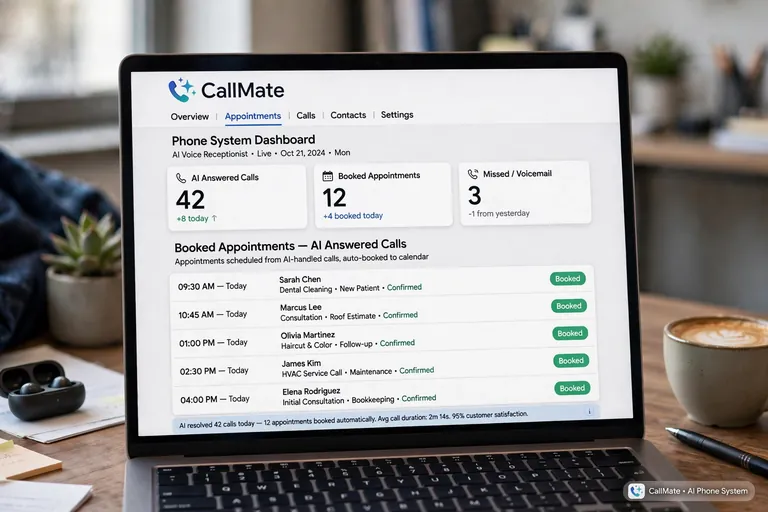
Step 2: The agent talks and acts. It greets the caller with your script, asks what they need, and checks your facts. It can answer hours, prices, and service questions, check calendar slots, book the visit, take a message with names and numbers spelled right, or send a text link to book online. Every call is recorded as a transcript you can read later.
Step 3: It hands off or follows up. If the call is simple, the agent finishes it and sends you a summary by text, email, or app alert. If the call is urgent, angry, or off-script, it transfers to you or your on-call staff with a spoken briefing, so the caller never repeats the story. After the call, details can flow into your CRM or calendar without retyping.
Set this up right and your phone becomes a system, not a chore. Calls get answered, booked, or flagged. Nothing sits in a voicemail box until Monday.
What it can and cannot do
An ai voice agent for small business shines on repeatable calls. These are the calls that follow a pattern and need facts, not judgment.
It can:
- Answer hours, location, prices, and service questions
- Book, reschedule, and confirm appointments
- Take messages with names, numbers, and job details
- Qualify leads with 3 to 5 set questions
- Route callers to the right person or team
- Send a text confirmation or booking link after the call
- Screen spam and robocalls before they reach you
- Answer in more than one language on many plans
It cannot do well:
- Calm a furious customer who wants a human now
- Give medical, legal, or safety advice beyond your approved script
- Judge a complex quote that needs eyes on site
- Fix a billing dispute with missing records
- Replace a human for high-trust, high-value sales talks
The rule is simple. Let the agent own the predictable calls. Let humans own the emotional, regulated, and complex ones. Businesses that draw this line clearly get the best results. Businesses that let the agent improvise on everything get complaints.
Cost in plain numbers
For an ai voice agent for small business, most small firms pay $30 to $500 a month for a managed plan. Developer platforms charge per minute instead. Here is how the models break down, using prices published by top guides in 2026.
- Starter managed plan: $30 to $60 a month, often 200 to 500 minutes included, shared voice.
- Growth managed plan: $60 to $200 a month, custom voice, more minutes, calendar and CRM links.
- Pro managed plan: $200 to $500 a month, higher volume, more than one agent, advanced routing.
- Developer platform: $0.07 to $0.31 per minute all-in, plus phone line costs. Cheap at low volume, but you build it yourself.
- Hybrid AI plus human: $250 to $1,200 a month. AI answers first, live staff catch the hard calls.
Real tool prices make this concrete. Rosie starts at $49 a month for 250 minutes. CloudTalk lists its AI Receptionist at $99 a month for 200 minutes, with a free tier of 50 minutes. Goodcall starts at $79 a month for 100 unique callers, with unlimited minutes on paid plans, so a busy week cannot spike the bill. Dialzara starts at $29 a month for 60 minutes. JustCall charges $0.99 per minute pay as you go, or $99 for 100 minutes and $249 for 300 minutes a month. Smith.ai starts free for 25 calls a month, then paid plans from $150 a month for 75 calls, with live humans behind the AI.
Now do peak-month math, not average-month math. A shop that takes 400 minutes in a normal month may take 900 minutes in a busy month. On a 200-minute plan with overage fees, that busy month hurts. On a per-caller plan like Goodcall, it does not. Before you buy, ask three questions: What counts as a billable minute? What is the overage rate? Are outbound minutes billed apart from inbound? Get the answers in writing. Hidden fees live in those three answers.
Compare the total to the alternative. A part-time receptionist runs $1,500 to $2,500 a month and covers limited hours. A full-time receptionist runs $3,000 to $4,500 a month and still misses nights and weekends. One recovered job a month often pays for the agent. Leads called back within five minutes convert far better than leads called back after 30 minutes, per research cited by top guides. Speed alone often covers the fee.
Best tools by business type
The best ai voice agent for small business depends on your shape, not on a ranking list.
CloudTalk: best inside a full phone system. If you already need a business phone system, CloudTalk puts the agent inside it. Its AI Receptionist answers, captures intent, and routes by what the caller said, not by a menu. Its AI Specialist can run a full workflow, like booking or outbound follow-up from your CRM. It supports 60-plus languages and links to HubSpot, Salesforce, Pipedrive, Zoho, Zendesk, and Google Calendar. Start at $99 a month for 200 minutes.
Rosie: best for solo owners. Rosie trains itself from your website, so setup is fast. It books into your calendar, texts booking links, transfers live with a spoken briefing, and answers in English and Spanish with 10-plus voices. It has mobile apps, so summaries land on your phone. Start at $49 a month for 250 minutes. Pick this if you just need every call answered and you work alone or with one helper.
Goodcall: best for spiky volume. Goodcall bills per unique caller, not per minute. A burst week costs the same as a quiet week if the same people call. Plans start at $79 a month for 100 unique callers, with unlimited agents per account. It forwards from your current number and links through Zapier. Pick this if your call volume swings with seasons, storms, or sales.
Smith.ai: best with human backup. Smith.ai pairs AI answering with live US-based receptionists. Hard calls move to a person mid-talk. It screens leads, runs intake with set questions, filters spam against a 20-million-plus number database, and links to Clio, HubSpot, Salesforce, and Calendly. Free for 25 calls a month, then from $150 a month for 75 calls. Pick this for law firms, clinics, and firms where one missed inquiry can cost thousands.
Dialzara and My AI Front Desk: best budget no-code picks. Dialzara starts at $29 a month for 60 minutes and suits small teams that want plug-and-play answering. My AI Front Desk starts around $99 a month for 200 minutes and suits solo pros and agencies that resell receptionists to clients. Both need no code and go live fast.
Retell AI and Vapi: best if you have a developer. Retell AI charges $0.07 to $0.31 per minute all-in and gives deep control over voice, model, and phone setup. Vapi charges from $0.05 per minute for its platform layer, plus model and voice costs, with all-in rates near $0.25 to $0.33 per minute. Both need engineering time. Do not pick these if you want a working receptionist this week with no code.
Slang.ai: best for restaurants. Slang.ai is built for restaurant calls: reservations, hours, menus, and order questions. It starts near $399 a month per location. If you run a restaurant, a niche tool that knows your rush hours beats a generic agent.
Set it up in one day
Most no-code options for an ai voice agent for small business go live in under an hour. Here is a plan that works.
- List your top 10 caller questions. Hours, prices, booking, rescheduling, directions, and service scope cover most calls. Write one short approved answer for each.
- Write your greeting and your handoff rule. Example greeting: "Thanks for calling Bright Fix Plumbing. How can I help?" Example rule: "If the caller says flood, gas smell, or emergency, transfer to the on-call phone at once."
- Link your calendar. The agent must write a real booking into your calendar, not email you a note to retype. Test this with a fake booking.
- Set spam rules. Let the agent screen robocalls and sales calls so they never ring your phone.
- Make test calls. Call your own number from a noisy street, from a car, and with an odd address. Check that names, dates, and numbers come out right.
- Turn it on for after-hours first. Let it prove itself at night and on weekends for one week, then extend it to all hours if transcripts look clean.
- Read transcripts daily for two weeks. Fix wrong answers at once. A small prompt fix now stops 50 bad calls later.
Your prompt is your training manual. Keep it short, plain, and strict. Tell the agent what it may say, what it must never guess, and when it must transfer. If it does not know an answer, it must say so and take a message. Guessing is the top cause of bad AI calls.
7 mistakes to avoid
- No handoff rule. Every agent needs a clear exit to a human. Test it. Call and say, "Let me talk to a person," and see what happens.
- A prompt that is too long. A 20-page script confuses the agent. Keep facts short and rules clear.
- No calendar link. An agent that cannot book is just a fancy voicemail box.
- Ignoring transcripts. Owners who never read calls keep paying for the same error.
- Pricing on averages. Price for your peak month, then pick the plan.
- Hiding that it is AI. Tell callers in the greeting if your local rules ask for it, and always offer a human path. Trust beats tricks.
- Letting it handle regulated advice. Medical triage, legal advice, and safety calls need approved scripts and fast human transfer, plus a signed compliance deal (called a BAA) for health data where required.
Who should not buy one yet
An ai voice agent for small business is not right for every firm today. Skip it, or delay it, if any of these fit you.
- Your calls are mostly long, emotional, or high-trust sales talks where a human voice closes the deal.
- You have no one to take transfers, and no on-call rota for urgent calls.
- Your bookings need a custom quote on every call, with photos and site checks.
- You work in a regulated field and cannot yet get a signed compliance deal from the vendor.
- Your call volume is under 20 calls a month and voicemail plus fast callbacks already work fine.
If you sit in one of these groups, a hybrid plan with live humans, like Smith.ai, or a part-time human receptionist may fit better. Revisit AI answering when your volume grows or your after-hours misses pile up.
AI agent vs voicemail vs receptionist
Here is the choice in one view.
- Answer speed: agent answers on the first ring, every time. Voicemail never answers live. A receptionist answers only when staffed.
- Hours covered: agent covers 168 hours a week. A full-time receptionist covers about 40. Voicemail covers zero live hours.
- Calls at once: agent takes many calls at once. A receptionist takes one call at a time.
- Cost: agent runs $30 to $500 a month. A receptionist runs $3,000 to $4,500 a month fully loaded.
- Consistency: agent gives the same greeting every time. Human quality varies with mood, training, and workload.
- Nuance: humans win on sensitive and complex calls. Agents win on speed, coverage, and repeat tasks.
- Follow-up: agent sends instant summaries and books into your calendar. Voicemail waits until someone listens.
The smart setup for an ai voice agent for small business is a mix: AI as the first line, humans on the hard calls. You keep the low cost and full coverage, and you keep the human touch where it counts.
The 5-call test before you pay
Do not buy on a demo video. Run these five calls in your trial week. Make one from a noisy place.
- A routine booking. Book a normal service for a set day. Check the date, time, and name in your calendar.
- An emergency. Say you have a burst pipe or an urgent fault. Check that the agent transfers fast or alerts your on-call phone.
- A hard address. Give a long street name, a flat number, and a tricky spelling. Check the transcript for errors.
- An off-script question. Ask something your business does not offer. The agent must say it does not know, not invent an answer.
- A frustrated caller who interrupts. Talk over the agent, ask for a person, and change your mind mid-sentence. Check that it stays calm and transfers cleanly.
Score each call: right answer, right booking, right transfer, clean transcript. If any call fails twice, fix the prompt or switch tools. The off-script call tells you the most. Any agent can book a simple visit. Only a good one knows when to stop and hand over.
Conclusion
Missed calls are lost jobs, and voicemail does not save them. A voice agent answers fast, books the work, and sends you clean summaries, day and night, for a small monthly fee. Pick by your business shape: Rosie for solo owners, Goodcall for spiky volume, Smith.ai for human backup, CloudTalk if you need a full phone system, Retell AI or Vapi only if you have a developer.
Start small. Launch after-hours first. Read transcripts for two weeks. Fix the prompt fast. Run the 5-call test before you commit. Do that, and your phone stops being a leak and starts being a booking machine. For a related read on how AI search changes what customers find first, see how AI search works for small firms and pair this guide with our suggested AI tools roundup for small firms when you plan your next upgrade.
FAQ
What is an ai voice agent for small business?
It is software that answers your business phone in a natural voice, understands what the caller wants, and acts on it. It can answer questions, book appointments, take messages, and transfer urgent calls to a person, 24 hours a day.
How much does an ai voice agent for small business cost?
Most small firms pay $30 to $500 a month for a managed plan. Entry plans start near $29 to $49 a month. Developer platforms charge $0.07 to $0.31 per minute plus phone costs. Hybrid plans with live humans run $250 to $1,200 a month.
Can an AI voice agent book appointments?
Yes, if it links to your calendar or booking tool. Check that it writes a full booking into your system during the call. If it only emails you a summary to retype, it is not a real booking, and errors will creep in.
Will callers know they are talking to AI?
Often they will not on short routine calls, because modern voices sound natural and replies come fast. Many firms still state it in the greeting, and every caller should get a fast path to a person on request. Honesty builds trust and cuts complaints.
Is an AI voice agent better than voicemail?
Yes, for most firms. Voicemail waits. An agent answers, books, and alerts you at once. Top guides note that most callers who hit voicemail hang up and call a competitor instead of waiting for a callback.
Can AI voice agents handle multiple calls at once?
Yes. Unlike one receptionist, an agent can take many calls at the same time, so a busy hour does not produce engaged tones or missed calls. This is one of the largest gains for firms with sharp peaks.
Are AI voice agents HIPAA compliant?
They can be, but only with the right setup. Every layer that touches health data, the speech tool, the language model, and the phone line, needs a signed Business Associate Agreement, plus encryption and access controls. Confirm this in writing before launch if you handle health data.
Do I need a developer to set one up?
No, not for no-code tools like Rosie, Goodcall, CloudTalk, or Dialzara. You fill in business facts, set rules, link your calendar, and test. Developer tools like Retell AI and Vapi need engineering time and suit custom builds.
What happens if the AI cannot handle a call?
It should transfer to a person, text your on-call staff, or capture a detailed message with a callback number. Set this rule before launch and test it with a frustrated-caller test call. A clean handoff matters more than a clever voice.
Which AI voice agent is best for a small business?
It depends on your shape. Solo owners suit Rosie. Firms with spiky volume suit Goodcall. Firms that need human backup suit Smith.ai. Firms that need a full phone system suit CloudTalk. Firms with a developer suit Retell AI or Vapi.